How to Locate a Gas Line Underground
By Malone Detecting Solutions · Updated
To locate a gas line underground, put a signal on the pipe where it comes out of the ground, at the meter or riser, and follow it with the receiver of a pipe and cable locator. A gas pipe with a meter can have an insulated joint, so bridge it with a jumper cable and ground the service, or the signal won't travel down the buried line. That works on steel gas pipe. A plastic gas line carries no signal of its own, so the locator follows the tracer wire, the markers or the tape laid with it.
The steps below come from the manufacturers' manuals for the locators we sell (Vivax-Metrotech, Schonstedt and Fisher), which are written for utility crews and trained locators (Vivax-Metrotech's VM-810 handbook says its equipment is for trained operators, not for household or consumer use). The gas meter belongs to the gas utility, so the hookup at the meter is a job for the utility's crews and the locators who work on gas services. The ownership split comes from Columbia Gas of Ohio.
| Your gas line is | What finds it | Tool |
|---|---|---|
| Steel or other metal pipe | Transmitter clipped on at the meter or riser, receiver follows it | Pipe and cable locator |
| Plastic with tracer wire | Transmitter clipped to the tracer wire | Pipe and cable locator |
| Plastic with EMS markers | The buried markers along the route | Marker locator |
| Plastic with shallow tracer tape | The foil tape, 8 to 10 in down | Pipe locator, or a valve and box locator |
How to locate a gas line underground, step by step

1. Call 811 before anyone digs
811 is the free call-before-you-dig number: the utilities send someone out to mark their own lines. Columbia Gas of Ohio puts it simply: begin any project, big or small, with a call to 811.
2. Work out which lines are yours
Columbia Gas of Ohio owns and inspects the gas lines up to and including the meter. The customer owns the lines from the meter to the gas appliances. That includes buried lines out to pool heaters, generators and other outdoor appliances, and Columbia asks customers to have those outside lines marked before any digging on the property. Because the meter is the utility's, a homeowner's job here is to get those lines marked, not to hook equipment onto the meter.
3. Clip the transmitter on at the meter or riser (direct connect)
This step and the two after it are for utility crews and trained locators, since the meter and the pipe up to it belong to the gas utility. Direct connect is the mode the manuals say to use first. Vivax-Metrotech calls it "the preferred mode of operation", and both Schonstedt manuals (Rex and u-Locate) name the gas meter as a place to clip on.
- With the transmitter off, clip the red lead to clean, bare metal on the gas service, at the point where the pipe comes up out of the ground.
- Set the transmitter down off to the side, at a right angle to the way the line runs.
- Run the black lead out as far as it reaches, still at that right angle, push the ground stake in as deep as it goes and clip the black lead to it.
- Turn the transmitter on, on low power first. Vivax-Metrotech says low power keeps the signal from bleeding onto other lines and saves the batteries; go to high only if the signal is weak or unstable.
If you can't clip onto bare metal, a signal clamp around the riser induces the signal instead. Schonstedt's Rex manual names the gas meter as a clamp point too, and no ground stake is needed in clamp mode.
4. Bridge the insulated joint at the meter
Vivax-Metrotech gives a gas pipe with a meter as its example of a pipe with an insulated joint, and an insulator keeps the signal from carrying through. Vivax-Metrotech's fix is a jumper cable: attach one end on each side of the insulator, so the signal can carry past it onto the buried line.
5. Ground the service
To locate gas services on a distribution system, Vivax-Metrotech says the service has to be grounded. Do it by temporarily connecting a jumper cable to a ground spike at the end of the service, where the pipe comes out of the earth. Without a complete circuit, very little of the transmitter's signal reaches the receiver.
6. Walk the line and read what the signal tells you
Sweep the receiver side to side as you walk. The reading climbs as you get close and peaks right over the pipe. Mark the line as you go.

- A slow fade as you move away from the transmitter is normal.
- A sudden drop means the line changed direction or stopped.
- A reading that jumps up and falls back means you probably passed over a buried valve, tee or riser.
- An abrupt change in the current reading means you're no longer over the gas line, or you passed a tee.
Where gas, water, power and phone share a trench, the signal can carry onto the line next to yours and show a "ghost" trace between the two. Vivax-Metrotech lists three signs: the guidance needle moves the same way you're moving instead of the opposite way, the signal gets weaker as you move toward the line, and a depth reading comes back random or "Error". Backtrack and search in a 180° arc to pick the real line up again.
How do you know where your gas line is?
Start at the meter. That's where the utility's line ends and yours begins, and it's where a locating crew puts the signal on the buried pipe. From there, the customer-owned lines run on to the gas appliances, in the house and outside.

Are gas lines usually in the backyard or front?
There's no rule you can count on. The meter tells you where your line starts, and the buried lines go wherever the gas appliances are: Columbia Gas of Ohio names pool heaters, generators and other outdoor appliances. Have the lines to each one traced from the meter and marked before you dig.
How do I know where the gas line is in my house?
The gas line enters past the meter and runs to each gas appliance. Columbia Gas of Ohio puts the lines from the meter to the appliances on the customer's side. Indoors you're following pipe you can see; this guide covers the buried part outside.
Does 811 locate all lines?
811 gets the utilities to mark the lines they own. For gas, Columbia Gas of Ohio owns the lines up to and including the meter, and the customer owns everything from the meter to the appliances. Columbia's own advice is to have your outside gas lines, from the meter to your gas appliances, marked before any excavation on your property, and to have them inspected for leaks and corrosion now and then. Those customer lines get found by a crew tracing them from the meter with a pipe and cable locator.

How do you find a plastic gas line?
Not with the signal alone. Vivax-Metrotech's manual is direct about it: electromagnetic locators find metal conductors only. A plastic (polyethylene) gas line is found by what was buried with it.

- Tracer wire. Clip the transmitter to the tracer wire where it comes up above ground and trace it like metal pipe. Vivax-Metrotech lists tracer wire as a direct-connect point.
- EMS markers. Passive markers are buried along plastic water and gas lines to mark the route. Vivax-Metrotech's vLoc3 manual has a marker mode with a gas marker setting (vLoc3-ML, or the vLoc3-MLA adapter on a vLoc3 receiver).
- Tracer tape. Fisher's TW-6 manual describes aluminum foil tape sandwiched in printed mylar, laid in the trench above a non-metallic pipe. It can be traced like a line, and when it's only 8 to 10 inches down, a valve and box locator such as the Fisher M-66 picks it up.
Why a metal detector finds the tape but not the pipe: can a metal detector find underground pipes?
Is there a map of gas lines?
For the big ones, yes. The National Pipeline Mapping System (NPMS), run by the US Department of Transportation's pipeline agency (PHMSA), maps hazardous liquid and gas transmission pipelines. Those are the big cross-country lines, not the service line to a house or the buried lines in a yard. Utilities keep their own records: Columbia Gas of Ohio is measuring the location of its natural gas lines with GPS. The lines past your meter aren't on either, which is why they get traced and marked.

Where can I find a gas pipeline map?
At npms.phmsa.dot.gov, the National Pipeline Mapping System, for transmission pipelines. For the gas main and service on your street, ask the gas utility; for the lines on your side of the meter, have them traced and marked.
How far down are gas lines usually buried?
There's no single depth to count on, so read it at a few points along the line. Stand over the peak, face along the pipe, hold the receiver straight up with the tip on the ground and press the depth button. The reading is to the center of the pipe. Vivax-Metrotech rates the VM-810's depth reading within 5% on a clean signal, and Schonstedt's Rex reads depth to about 19 ft.

Depth also changes which mode works. Vivax-Metrotech warns that the inductive mode (the transmitter set on the ground over the line, nothing clipped on) may struggle on a line 3 ft or deeper, or in new backfill. On a gas service, crews clip on at the meter instead. Schonstedt's u-Locate manual says not to use a depth estimate to decide whether to dig with a machine.
What is the easiest way to find underground pipes?
Clip on. Direct connect puts the strongest signal on the pipe and the least on the lines around it, and the manuals say to try it first. The same steps find a metal water line: start at the curb stop or meter, as in our guide on how to locate a water line underground.
What is a good tool for finding gas lines?
A pipe and cable locator, a transmitter and a receiver, is the tool that follows the line. Here's how the job splits across the gas line locators we carry:
| Job | Type | Models |
|---|---|---|
| Trace a steel gas service from the meter, across insulated joints | Pipe and cable locator, 83 kHz | Vivax-Metrotech VM-810 |
| Trace gas, water and electric lines from one kit | Multi-frequency pipe and cable locator | Schonstedt Rex |
| Trace with arrows toward the line and one-button depth | Pipe and cable locator | Schonstedt u-Locate |
| Trace with depth and current readouts | Utility locator receiver | Vivax-Metrotech vLoc3-Pro, vLoc3-9800 |
| Find a line you can't clip onto | Inductive search | Fisher TW-6, VM-810 |
| Find shallow tracer tape over plastic pipe | Valve and box locator | Fisher M-66 |
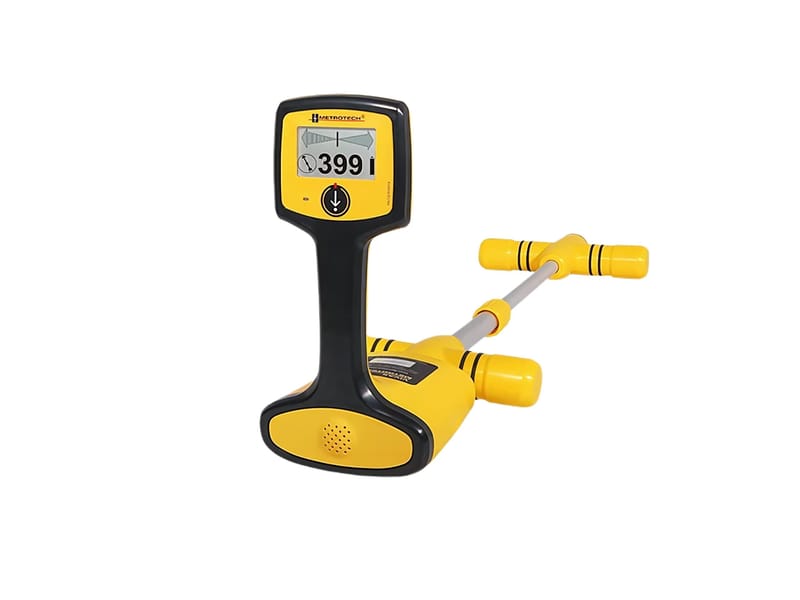
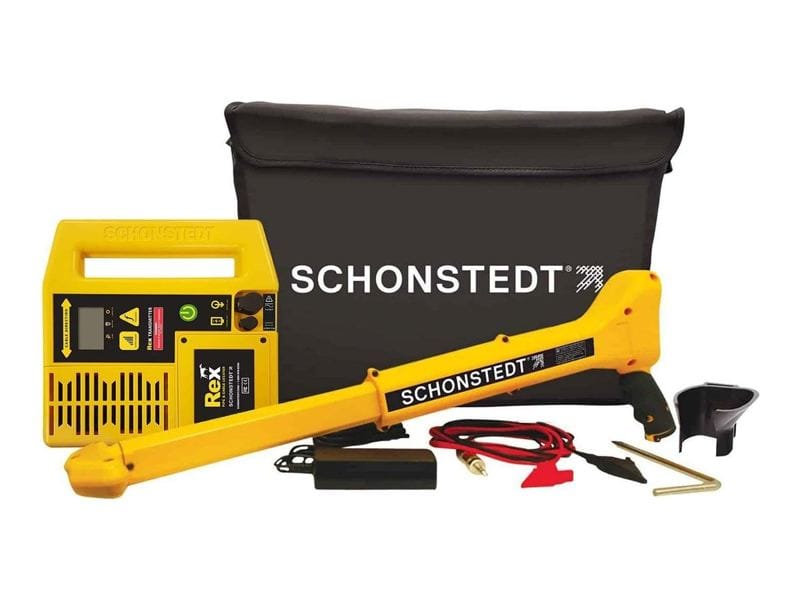
For a gas utility crew, the Vivax-Metrotech VM-810 is made for tracing water and gas distribution lines, and its 83 kHz signal can jump the insulators and rubber gaskets common in gas systems. It works with the jumper cable for insulated joints at the meter. The Schonstedt Rex pipe and cable locator covers gas, water, sewer, electric and telecom on three frequencies (512 Hz, 33 kHz and 82 kHz) and reads depth to about 19 ft. The Schonstedt u-Locate pipe and cable locator names gas meters among its hookup points. The Vivax-Metrotech vLoc3-Pro reads depth and current and finds sondes. For tracer tape over a plastic line, the Fisher M-66 metal detector reads it when it's 8 to 10 inches down.
Malone Detecting fits gas and public utility crews, the customers we mainly serve, who want the sale and the repair from one place: Joe Malone services the Fisher locators we sell.
Sources
- Vivax-Metrotech VM-810/VM-850 User Handbook (direct connection p. 19–20; signal clamp p. 20–21; insulated joints, grounding gas services, ghost traces, current readings, valves and tees p. 30–33; depth p. 23–25)
- Vivax-Metrotech vLoc3 manual (EMS marker locating, p. 34–37)
- Schonstedt Rex Manual and Rex Brochure; Schonstedt u-Locate Manual
- Fisher TW-6 Manual (tracer tape, non-metallic pipe)
- Columbia Gas of Ohio: Gas Line Responsibilities and Locating Gas Lines pages (columbiagasohio.com, read Oct 23, 2026)
- PHMSA National Pipeline Mapping System (npms.phmsa.dot.gov, read Oct 23, 2026)
- Whitney Malone, call of Sept 29, 2026 (customers: gas and public utilities)