Can a Metal Detector Find Underground Pipes?
By Malone Detecting Solutions · Updated
A metal detector for underground pipes will find metal pipe that's right under its coil, but it won't follow the pipe across a yard. Fisher says so in the manual for its M-66 valve and box locator: the M-66 "is a Metal Detector which should not be a substitute for a Utility Line Tracer." What finds a buried pipe depends on what the pipe is made of. A magnetic locator finds iron and steel pipe and ignores copper. A pipe and cable locator follows any metal pipe and the tracer wire laid with plastic pipe. Plastic pipe on its own carries nothing a detector can pick up.
Everything below comes from the manufacturers' manuals for the three kinds of tools we sell: Fisher (metal detector), Schonstedt (magnetic locator) and Vivax-Metrotech (pipe and cable locator).
| Pipe | Metal detector | Magnetic locator | Pipe and cable locator |
|---|---|---|---|
| Cast iron or steel | Only right under the coil; won't follow it | Yes: strongest at the joints | Yes: clip on and follow it |
| Copper | Only right under the coil; won't follow it | No | Yes: clip on and follow it |
| Plastic with tracer wire | No | No | Yes: clip on to the tracer wire |
| Plastic with tracer tape 8 to 10 in down | Yes, the tape | No | Yes, the tape |
| Plastic with nothing buried with it | No | No | Only with a sonde or fish tape pushed down the pipe |

Magnetic locator vs metal detector
They answer different questions. A metal detector asks "is there metal under this coil?" A magnetic locator asks "is there iron or steel down there?"

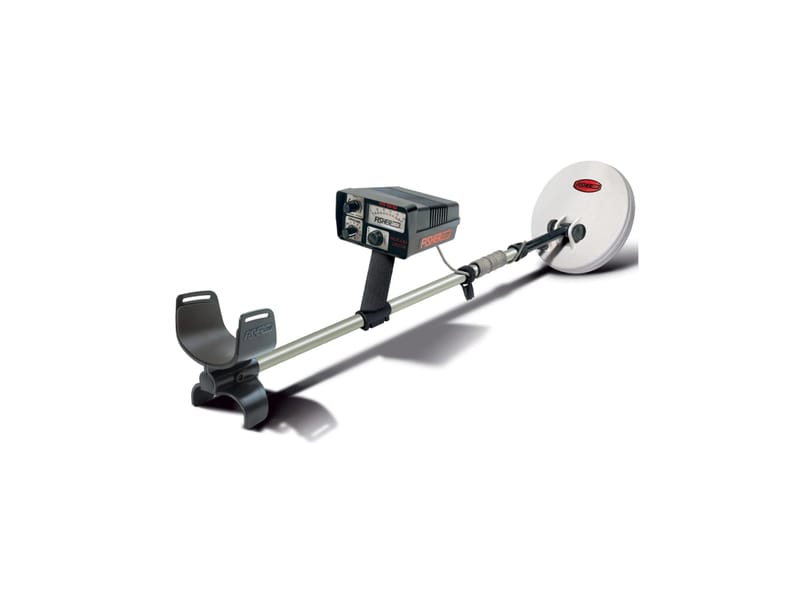
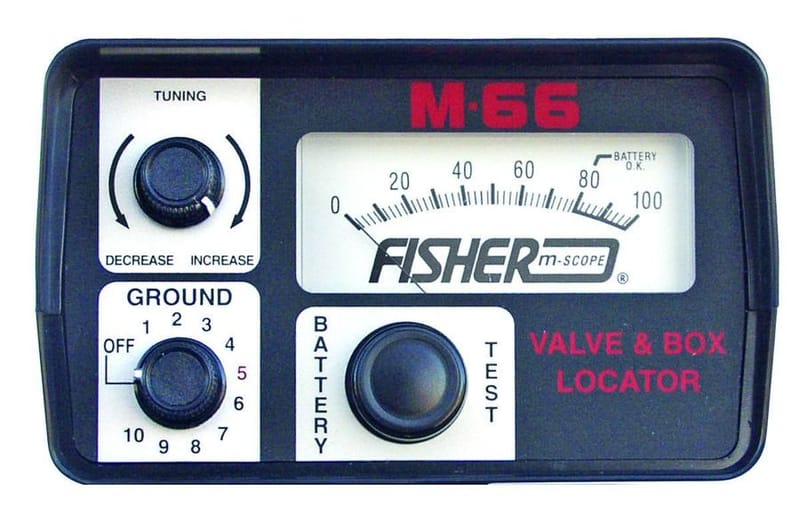
- A metal detector sends a signal from its search coil (the Fisher M-66 has an 8-inch Double D coil running at 4.5 kHz) and beeps and moves its needle when the coil passes over metal. Fisher calls the M-66 an all-metal detector made for the utility industry, and it searches through concrete and asphalt. It needs tuning to the ground: a ground control balances out the minerals in the soil.
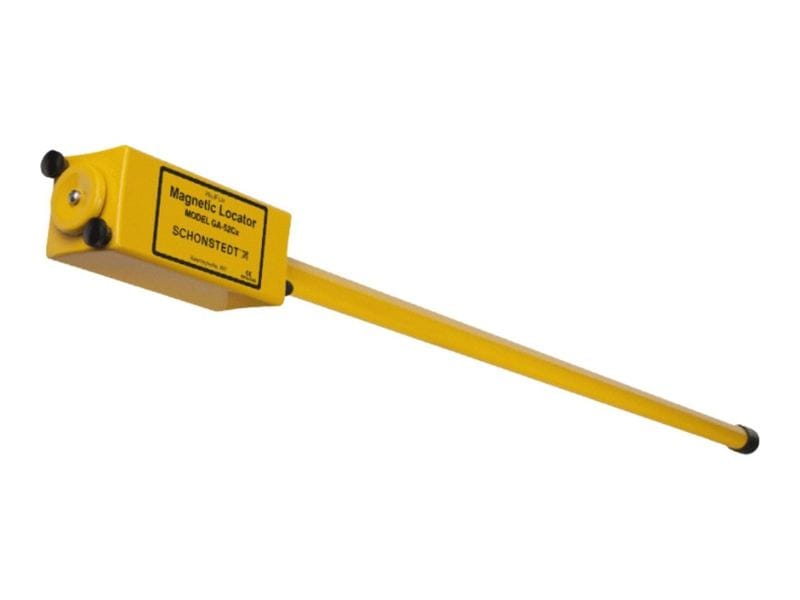
- A magnetic locator has two sensors about 20 inches apart and responds to the difference in the magnetic field between them. Schonstedt's GA-52Cx manual says it detects the magnetic field of ferromagnetic objects, that is, iron and steel. Its tone climbs as you get closer.
| Metal detector (Fisher M-66) | Magnetic locator (Schonstedt GA-52Cx) | |
|---|---|---|
| Reacts to | Any metal under the coil | Iron and steel only |
| Ignores | Nothing metal | Gold, silver, copper, brass, aluminum |
| Pipe | Only the part under the coil | Cast-iron pipe, strongest at the joints; 4 in pipe to 10 ft |
| Depth figures in the manual | None given | Manhole cover 10 ft, well casing 18 ft, 4 in pipe 10 ft |
| Made for | Valve boxes and buried metal objects, through pavement | Iron pins and markers, valve boxes, covers, cast-iron pipe |
| Follows a pipe? | No: "should not be a substitute for a Utility Line Tracer" | Cast-iron pipe, joint by joint, by its peaks; no signal to follow |
So for an iron or steel target, the magnetic locator is the specialist, and Schonstedt's manual lists depths for it. For a box lid or another metal object, including non-iron metal, the metal detector is the one that responds. Neither one follows a pipe from end to end like a pipe and cable locator.
What metals cannot be detected by a magnetic locator?
Schonstedt's GA-52Cx manual names them: gold, silver, copper, brass and aluminum. A magnetic locator finds iron and steel only, so it can't find gold. That's also why crews use it: it stays quiet over copper and aluminum and speaks up over an iron valve box or pipe.
How do you find a cast-iron pipe with a magnetic locator?
By its joints. Schonstedt's GA-52Cx manual says cast-iron pipe gives its strongest magnetic signal at the joints, so a buried cast-iron line shows up as a row of peaks.

- Sweep the area first to get the general direction of the pipe.
- Set the sensitivity to maximum.
- Hold the locator upright, about 1 to 1-1/2 feet above the ground.
- Walk along the pipe without turning or tilting the locator.
- Mark each spot where the signal peaks. Those are the joints.
- Go back to a peak and hold the locator a few inches above the ground. You'll probably need to turn the sensitivity down on this second pass.
Schonstedt says a 4-inch pipe can be found this way at up to 10 feet. The same manual uses the GA-52Cx on iron valves and valve boxes, which give strong fields because the valve and its casing are both iron. Our magnetic locators page compares the four Schonstedt models and the Vivax-Metrotech VM-880.
Can a metal detector find plastic pipe?
No. Plastic pipe isn't metal, so a metal detector and a magnetic locator both pass straight over it, and even a pipe and cable locator can't see it: Vivax-Metrotech's VM-810 handbook says electromagnetic locators are designed to locate metallic conductors only. Plastic pipe is found by what's buried with it, or by something you push down it.

- Tracer wire. Clip the pipe and cable locator's transmitter to the tracer wire where it comes up above ground and follow it. Vivax-Metrotech lists tracer wire as a direct-connection point.
- Tracer tape. Fisher's TW-6 manual describes foil tape sandwiched in printed mylar, laid in the trench above a non-metallic pipe. A line locator can follow it, and when it's only 8 or 10 inches down, a valve and box locator such as the Fisher M-66 can trace it too. This is the one case where a metal detector does follow a plastic line: it's following the foil.
- A fish tape or snake. Fisher's TW-6 manual: run an electrician's fish tape or a plumber's snake down the pipe, clip the transmitter to it and trace it. The signal stops where the tape stops, which also shows where a blockage is.
- A sonde. Vivax-Metrotech says a sonde, a small transmitter pushed through the pipe, is typically used for non-metallic pipes and ducts.
Our guide on how to locate a water line underground walks through each of these on a plastic water service.
Will a metal detector detect copper pipe?
A metal detector will react to copper under its coil, because it isn't limited to iron: Fisher calls the M-66 an all-metal detector. It still won't follow the line, and Fisher gives no depth figures for it. A magnetic locator won't detect copper at all; Schonstedt lists copper among the metals the GA-52Cx doesn't detect.

To find where a copper line runs, put a pipe and cable locator on it. Copper is a metal conductor, so a transmitter clipped to the pipe at a valve, a meter or a riser puts a signal on it that the receiver follows.
Can you find a gas line with a metal detector?
Not to follow it. A metal detector finds metal under its coil, and the M-66 manual says it "should not be a substitute for a Utility Line Tracer." A gas line is traced from the meter with a pipe and cable locator, and a plastic gas line by its tracer wire, its markers or its tracer tape. A metal detector helps only in that last case, when the tape is 8 to 10 inches down.
The gas meter belongs to the gas utility (Columbia Gas of Ohio owns the lines up to and including the meter), so hooking a locator onto it is a job for the utility's crews and trained locators. The steps they follow are in our guide on how to locate a gas line underground.
What metal detector can I use to find water pipes?
It depends on which part of the water service you're after:
- The curb box or valve box, a metal box near the surface: a metal detector such as the M-66, which reads through concrete and asphalt.
- An old cast-iron main: a magnetic locator, which finds it by its joints, as above.
- The service line itself, copper, iron or plastic with tracer wire: a pipe and cable locator, clipped on at the curb stop or the meter.
How does a pipe locator work?
A pipe and cable locator has two parts. The transmitter puts a signal on the buried pipe, and the receiver picks that signal up from above ground and follows it. Vivax-Metrotech describes three ways to get the signal on the pipe:

- Direct connection, the preferred mode. The transmitter clips to a metal part of the line (a hydrant, meter, riser, valve, cable sheath or tracer wire) and grounds to a stake. This gives the strongest signal and the least on the lines around it.
- Signal clamp, when you can't clip on but can get a clamp around the pipe. The clamp induces the signal.
- Inductive, when you can do neither. The transmitter sits on the ground over the line and broadcasts the signal through the soil. Vivax-Metrotech calls it the least preferred method, because other lines nearby pick the signal up too; keep the receiver at least 30 ft from the transmitter.
That's what lets it follow a pipe the whole way, which a metal detector or magnetic locator can't do. Our underground pipe locators page covers the split-box and transmitter-and-receiver types we carry.
What confuses a metal detector?
Both kinds of tool get thrown off by things the manuals name.

A metal detector (Fisher M-66):
- Ground minerals. The meter moves when the coil passes over metal, but also when the ground's mineral content changes. Set the ground control so lifting and lowering the coil makes no change.
- Weak batteries. Below 80 on the battery test, Fisher says depth can drop and accuracy may be in question.
- Big or shallow targets can seem larger than they are. Raise the coil and pass over again to find the edges.
A magnetic locator (Schonstedt GA-52Cx):
- Your watch and shoes. The upper sensor sits near your hand, so take off your wristwatch or switch hands, and keep the tip away from your shoes.
- Small iron junk. A signal that fades when you lift the locator or turn the sensitivity down is probably a small item, like a rusty bolt.
- Strongly magnetized markers near the surface can point you to the wrong spot. Sweep the whole signal area before you mark.
- A chain link fence. Turn the sensitivity down and hold the locator flat, at a right angle to the fence.
- A live power line makes a burbling sound.
Which tool finds which underground pipe?
| Job | Tool | Model we carry |
|---|---|---|
| Find a valve box or metal lid, even under pavement | Metal detector (valve and box locator) | Fisher M-66 |
| Find shallow tracer tape over plastic pipe | Metal detector | Fisher M-66 |
| Find iron valve boxes, covers and cast-iron pipe joints | Magnetic locator | Schonstedt GA-52Cx |
| Follow a metal pipe or tracer wire the whole way | Pipe and cable locator | See underground pipe locators |
The Schonstedt GA-52Cx magnetic locator finds iron and steel and ignores copper, brass and aluminum. It lists a 4-inch pipe at up to 10 ft and well casings at up to 18 ft, and it burbles near a live power line. The Fisher M-66 metal detector is the valve and box locator: an all-metal detector with two knobs that searches through concrete and asphalt, and picks up tracer tape when it's 8 to 10 inches down. Each of the three does a job the other two can't.
Malone Detecting fits gas and public utility crews, the customers we mainly serve, who want the sale and the repair from one place: Joe Malone services the Fisher locators we sell.
Sources
- Fisher M-66 Operating Manual, Rev.2 (description and "not a substitute for a Utility Line Tracer" p. 2; controls, ground balance, battery test p. 3–4; searching p. 5; specs p. 6)
- Schonstedt GA-52Cx Operation Manual (how it works p. 4; using it, wristwatch and shoes p. 5; small targets and magnetized markers p. 7; chain link fence p. 10; valve boxes and cast-iron pipes p. 11–12; power lines and non-ferrous metals p. 13); Schonstedt Magnetic Locators brochure (depth chart p. 5)
- Fisher TW-6 Manual (non-metallic pipe: fish tape, tracer tape, valve and box locator, p. 20)
- Vivax-Metrotech VM-810/VM-850 User Handbook (metallic conductors only; direct connection, signal clamp, inductive method p. 19–21; sonde for non-metallic pipe, section 4.6)
- Columbia Gas of Ohio: Gas Line Responsibilities (columbiagasohio.com, read Oct 23, 2026)
- Whitney Malone, call of Sept 29, 2026 (customers: gas and public utilities)