How to Locate a Water Line Underground
By Malone Detecting Solutions · Updated
To locate a water line underground, put a signal on the pipe and follow it: clip a pipe locator's transmitter to a metal part of the water service (the curb stop, the meter or a valve), drive the ground stake off to one side, then walk the line with the receiver and mark where the signal peaks. That works on copper, iron and steel. A plastic line carries no signal, so you give the locator something to find: the tracer wire buried with it, or a sonde pushed down the pipe.
The locating steps below come from the manufacturers' manuals for the locators we sell (Schonstedt, Vivax-Metrotech and Fisher).
| Your water line is | What finds it | Tool |
|---|---|---|
| Copper, iron or steel | Transmitter clipped to the pipe, receiver follows it | Pipe and cable locator |
| Plastic with tracer wire | Transmitter clipped to the tracer wire | Pipe and cable locator |
| Plastic, no tracer wire | A sonde or FlexiTrace pushed down the pipe | Locator with sonde mode |
| Any, but you need the curb box first | The iron box or valve itself | Magnetic locator or valve and box locator |
How to locate a water line underground, step by step

1. Call 811 before anyone digs
811 is the free call-before-you-dig number: the utilities send someone out to mark their own lines. Call it before any digging, then locate the water line you need.
2. Find the curb box or the meter
The curb box is the iron or plastic sleeve over the curb stop, the shutoff valve on the water service. It can end up buried or paved over. A magnetic locator picks up an iron curb box or valve 9 to 11 ft down, depending on the model (Schonstedt's own range table), and plastic boxes are fitted with a magnet so they can be found too. To find any metal box, iron or not, through concrete or asphalt, crews use one of the curb box locators built for it.
3. Clip the transmitter to the pipe (direct connect)
Direct connect is the mode every manual says to use first. Schonstedt's Rex and u-Locate manuals both call it "the strongest and best coupled signal", and Vivax-Metrotech calls it "the preferred mode of operation".
- With the transmitter off, clip the red lead to clean, bare metal on the water service: the curb stop, the meter, a valve, a riser or a hydrant.
- Set the transmitter down off to the side, at a right angle to the way the pipe runs.
- Run the black lead out as far as it reaches, still at that right angle, push the ground stake in as deep as it goes and clip the black lead to it.
- Turn the transmitter on, on low power first. Vivax-Metrotech says low power keeps the signal from bleeding onto other lines and saves the batteries; go to high only if the signal is weak or unstable.
A good connection shows up as a change in tone when the clips go on (u-Locate) or in the transmitter's output current (Rex). If it doesn't, adjust the clips.
If you can't reach bare metal, two other modes work. A signal clamp goes around an exposed section of pipe and induces the signal without a ground stake. With nothing exposed at all, set the transmitter on the ground over the line and let it induce the signal through the soil. That last one is the weakest mode: start tracing at least 30 ft away from the transmitter, or the receiver picks up the transmitter itself through the air.
4. Walk the line with the receiver
Sweep the receiver side to side as you walk. The reading climbs as you get close and peaks right over the pipe. Set the gain so that peak reads between 200 and 800 on a Schonstedt receiver; a steady 995 or more means the signal is too strong, so turn the gain or the transmitter power down. Mark the line in blue, the APWA color for potable water.

Watch for two things the manuals warn about:
- The signal drops off suddenly. The line changed direction or stopped.
- The current reading jumps. A slow fade is normal as you get farther from the transmitter. A sudden change means you've crossed onto another line or passed a tee. Where water, gas, power and phone share a trench, the signal can carry onto the line next to yours. Vivax-Metrotech's fixes: change the connection point or mode, improve or move the ground stake, and keep the leads from crossing the other lines.
5. Read the depth
Stand over the peak, face along the pipe, hold the receiver straight up with the tip on the ground, and press the depth button. Vivax-Metrotech rates the VM-810's depth reading within 5% on a clean signal. The reading is to the center of the pipe, which on a big pipe can be well below its top, and Schonstedt's u-Locate manual says not to use a depth estimate to decide whether to dig with a machine.
How to find a water line from the meter to the house

The service line runs from the main under the street to the house, passing the curb stop and the meter on the way. Clip the transmitter on at the curb stop, at the meter or at the main shutoff inside the house, and trace toward the other end.
Vivax-Metrotech notes that water and gas systems often have insulators and rubber gaskets between sections. The VM-810's high-frequency signal (83 kHz) can jump them, and it's built for tracing water and gas distribution lines. The Schonstedt Rex has three frequencies to choose from: 512 Hz, 33 kHz and 82 kHz.
A gas service is traced the same way, with one extra step at the meter: see how to locate a gas line underground.
Is there a way to find PVC pipe underground?
Yes, but not with a pipe locator on its own. Vivax-Metrotech's manual is direct about it: electromagnetic locators find metal conductors only. Plastic water lines are found by adding something the locator can follow.

- Tracer wire. If a tracer wire was laid with the pipe, clip the transmitter to it where it comes up above ground and trace it like metal pipe. Vivax-Metrotech lists tracer wire as a direct-connect point.
- A sonde. A sonde is a small battery transmitter pushed down the pipe. You switch the receiver to sonde mode and look for it. Schonstedt's FlexiTrace is a 164 ft or 260 ft flexible rod with a sonde in the tip; it fits pipe as small as ½ in, and it can be found down to about 10 ft. Connect the transmitter to the rod instead and you can trace its whole length, not just the tip.
- Ground-penetrating radar or acoustic listening. Locate services use these on plastic pipe. We don't sell them.
What is the best homemade underground PVC pipe locator?
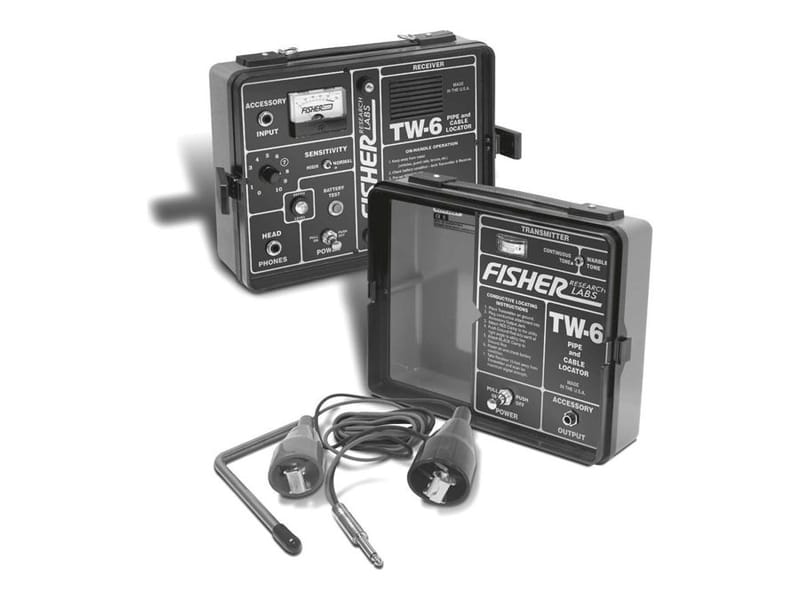
A locator can't see plastic itself. The method that works is in Fisher's TW-6 manual: run an electrician's fish tape or a plumber's snake down the pipe, clip the transmitter to it and trace the tape. It also shows where a blockage is, because the signal stops where the tape stops. Tracer tape (foil sandwiched in plastic, laid in the trench) can be found with a valve and box locator when it's only 8 to 10 inches down.
Can I use a metal detector to locate a water line?
Not to follow it. Fisher's manual for its M-66 valve and box locator says the M-66 "should not be a substitute for a Utility Line Tracer". A metal detector finds metal under the coil: the curb box, the valve box, a meter lid. It won't follow a buried pipe across a yard. The Fisher M-66 metal detector is still worth carrying for the boxes, because it reads through concrete and asphalt.
A magnetic locator finds only iron and steel, so it misses copper and plastic lines too. It does find a cast-iron main by its joints: Schonstedt's GA-52Cx manual says cast-iron pipe gives its strongest signal at the joints, and Schonstedt's brochure lists a 4-inch pipe joint at 10 ft for the GA-52Cx (9 to 11 ft across its five magnetic locators). Walk the locator steady, about a foot above the ground, and mark each peak.
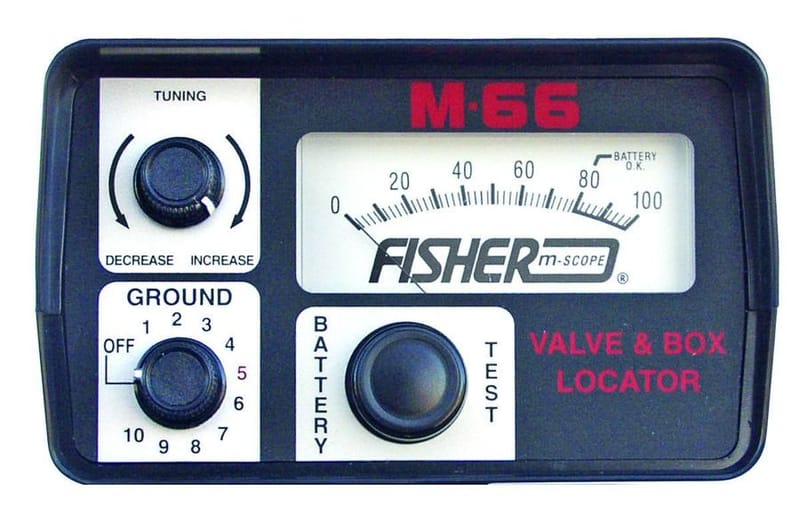
That's why water crews carry magnetic locators for valves, boxes and old iron mains, and a pipe and cable locator for the service lines.
For iron, copper and plastic pipe side by side, see can a metal detector find underground pipes?
What is a good tool for finding water lines?
A pipe and cable locator (a transmitter and a receiver) for the line itself, plus a magnetic locator or a valve and box locator for the curb box and valves. Here's how the job splits across the water line locators we carry:
| Job | Type | Models |
|---|---|---|
| Trace a metal service from the curb stop or meter | Pipe and cable locator, direct connect | Vivax-Metrotech VM-810, Schonstedt Rex, Schonstedt u-Locate |
| Trace a plastic line with no tracer wire | Locator with sonde mode | Rex, u-Locate+, vLoc3-9800 |
| Find a line you can't clip onto | Inductive search | Fisher TW-6, VM-810 |
| Find a buried or paved-over curb box | Valve and box locator | Fisher M-66 |
| Find iron valves, boxes and cast-iron mains | Magnetic locator | Schonstedt GA-52Cx, GA-72Cd, GA-92XTd, Spot |
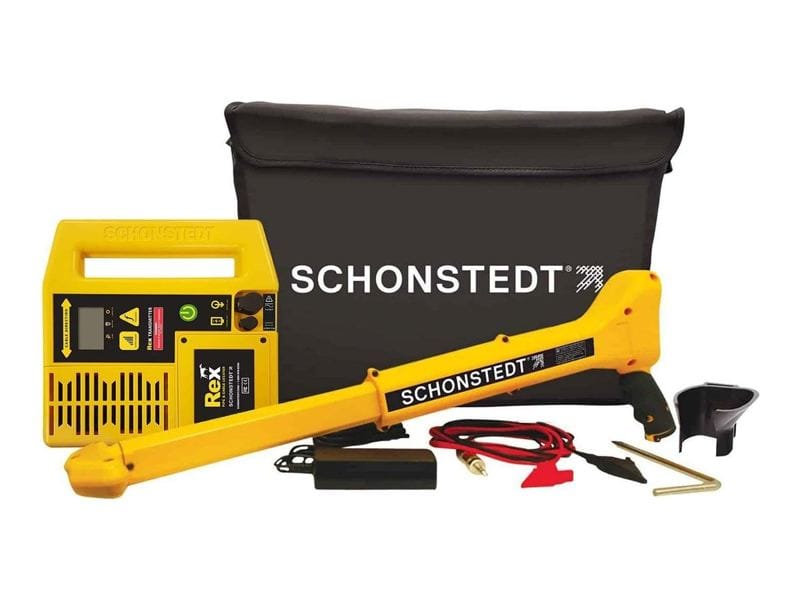
For a water department, the Vivax-Metrotech VM-810 is built for water and gas distribution, and its signal crosses the rubber gaskets common on water systems. For a crew that locates water, gas and electric in one truck, the Schonstedt Rex pipe and cable locator has three active frequencies, a passive power mode and sonde mode, and reads depth to about 19 ft. If you already own a Schonstedt receiver, the Schonstedt u-Locate transmitter puts the signal on the line.
Malone Detecting fits utility and public works crews that want the sale and the repair from one place: Joe Malone services the Fisher locators we sell. He tests the sensors and controls and replaces coils, latches and switches.
How deep is a water line usually buried?
There's no single depth. Local code sets how deep a water line goes, so ask the water utility or the local code office, and then read the actual depth with the locator at a few points along the line.

Schonstedt says a pipe and cable locator typically reads depth from 5 to 15 ft, and the Rex reaches about 19 ft.
How deep should PVC water lines be buried?
Local code sets it for plastic the same as for metal. What changes with plastic is finding it later: a pipe locator can follow it only through a tracer wire, a sonde or a tape run down the pipe.
How do I find a water leak underground?
Find the line first. A pipe locator shows where the line runs; it doesn't find the leak. Mark the line, so whoever looks for the leak knows where the pipe is.

Can you rent a pipe locator?
Yes. Equipment rental companies list buried pipe and line locators for rent by the day. We sell locators rather than rent them, and Joe Malone services the Fisher models we sell.
Sources
- Schonstedt Rex Manual and Rex Brochure; Schonstedt u-Locate Manual; Schonstedt Magnetic Locators brochure (range table); Schonstedt GA-52Cx Manual
- Vivax-Metrotech VM-810/VM-850 User Handbook
- Fisher M-66 Operating Manual; Fisher TW-6 Manual