How to Locate Underground Electrical Wires
By Malone Detecting Solutions · Updated
To locate underground electrical wires, sweep the ground with a pipe and cable locator in passive mode, which picks up the 60 Hz signal a live cable carries, with nothing hooked up. Then put a transmitter's signal on the wire you want to follow, so you can trace it from end to end and read its depth. A wire with no current flowing gives off nothing, so the transmitter is how you find a dead wire, and Schonstedt recommends using it on live ones too.
The steps below come from the manufacturers' manuals for the pipe and cable locators we sell that have a power mode: the Schonstedt u-Locate and Rex, and the Vivax-Metrotech vLoc3. We've laid them out for a buried wire on your own property: to a shed, a pump house, a detached garage or a post light.
Some of these steps are for a homeowner and some aren't. A passive sweep and induction don't touch the wire. Clipping onto a power cable, clamping a live cable and plugging into a live socket are jobs for an electrician or a trained locator. Schonstedt warns that its transmitter is capable of outputting potentially lethal voltages, and says connection to live power cables should only be undertaken by qualified personnel. Vivax-Metrotech says its equipment is for trained operators only, not for general household or consumer use. If the hands-off methods don't find your wire, call a private locator or an electrician.

| Your wire is | What finds it | Hooked up how |
|---|---|---|
| Live, with power being used | Passive (power) mode, set to 60 Hz | Nothing: the receiver alone |
| Live, but nothing switched on | Turn the load on, or use a transmitter | Switch it on; a clamp on a live cable is for an electrician or trained locator |
| Dead (no power at all) | Transmitter and receiver | Induce from the ground; clip-on or clamp by an electrician or trained locator |
| Broken or damaged | Transmitter and receiver, then an A-frame | An electrician or trained locator watches where the signal current drops |
How do I find buried electrical wire in my yard?
Start where you can see it. A buried wire to a shed or pump house comes up out of the ground at each end, at the house and at the outbuilding. Those ends tell you where to sweep, and the manuals put the signal on a line at a point where it comes up to the surface.

1. Call 811 before anyone digs
Call before anyone digs, but know what 811 won't cover. OHIO811 lists "electric lines extended from the house to a shed, lamppost, landscaping lights, pavilion, or other outdoor structure" as private utility lines, owned by the property owner, and says a private locating company may be required to identify them. We cover who marks what under does 811 locate all lines? in our gas line guide.
2. Set the receiver to 60 Hz
Power in North America runs at 60 Hz; many other regions use 50 Hz. Schonstedt's u-Locate manual says the receiver must be set to match the local power frequency to detect power signals in passive mode. The Rex comes preset from the factory, and it shows 50 or 60 briefly when you enter passive mode, so check that it reads 60.
3. Sweep the area in passive mode
Schonstedt recommends an initial sweep in passive mode, followed by detailed scans in the other modes. Leave the gain on automatic.

- Walk the outside edge of the area first.
- Walk its length in parallel passes about 18 inches apart, at a steady pace.
- When a cable shows up, find which way it runs, trace it across the area and mark it. Then go back to sweeping: finding a cable doesn't mean it's the only cable there.
4. Put a signal on the wire you're following
Passive mode tells you something live is down there. It can't tell you which wire it is, and it misses a wire with no current on it. Schonstedt's own warning: some power cables do not radiate detectable power signals, so use the transmitter whenever you search. The hands-off way is induction, in the dead-wire section below. Clipping or clamping onto a power cable is for an electrician or a trained locator.
5. Trace it and read the depth
Follow the signal from one end to the other, marking as you go. On the u-Locate, arrows show which way to move, and both arrows mean you're right over the line. Take depth readings with the transmitter's signal on the wire, the receiver's tip touching the ground, and only when both arrows show. Stay 3 feet or more from steel when you take a depth or current reading: Schonstedt says manhole covers, steel-toe boots and nearby vehicles can affect it.
How far below ground are electrical lines buried?
Read it at a few points along the line rather than guess. Schonstedt says the u-Locate typically reads depth up to 5 to 15 feet, depending on conditions, and shows three dashes (---) when it can't get a reading from a weak or distorted signal. The same manual is clear about what the number is for: don't use the depth estimate to decide whether to dig over the cable with a machine, and always dig with caution.
How do you detect underground electrical wires?
Two ways, and you'll usually use both. A live wire with current flowing already gives off a signal, and the receiver finds it on its own in passive mode. A dead wire gives off nothing, so you put a signal on it with a transmitter and the receiver follows that.

Will a metal detector find underground wires?
Not the way you need. Fisher's own manual for its M-66 says it "is a Metal Detector which should not be a substitute for a Utility Line Tracer." A pipe and cable locator follows the signal on the cable from end to end. We compare the tools in can a metal detector find underground pipes?
Can a locator pick up a live power line without a transmitter?
Yes, in passive mode, but "live" isn't the same as "locatable". The receiver picks up the current flowing on the cable. Vivax-Metrotech's vLoc3 manual puts it plainly: there has to be an electrical current flowing to create a detectable signal. A live cable that is not in use may not radiate a detectable signal, and a very well-balanced cable, with the same current in the live and the neutral, can cancel out. Vivax-Metrotech adds that this is unusual in practice, because most cables carry enough imbalance to give a good signal.

Passive mode can also pick up the wrong thing. Both Schonstedt manuals warn about interference from overhead power lines, other buried cables, pipes or utilities carrying 50 or 60 Hz signals, and nearby transformers or substations. If a signal you find doesn't match where the wire should go, confirm it with the transmitter.
How do you find buried landscape lighting wire?
Switch the lights on first, so current flows on the wire, and sweep in passive mode. If it doesn't show up, find it as a dead wire: power off, transmitter on, as in the next section.
How do you find a buried wire with no power on it?
Put a transmitter's signal on it. Induction is the hands-off way: nothing touches the wire. The clip-on and clamp hookups are for an electrician or a trained locator: Schonstedt says a connection to a power cable sheath should only be undertaken by qualified personnel, and its Rex manual warns that hazardous live voltage may be present at the output terminals in conductive mode.

- Induction (nothing touches the wire). Set the transmitter on the ground over where you think the wire runs, lined up the way your model's label shows. Schonstedt's u-Locate manual says to move at least 33 feet (10 m) away before you scan, because close in, the receiver picks up the transmitter itself instead of the wire. Repeat with the transmitter turned 90° for best results.
- For an electrician or trained locator: direct connect (strongest signal). Both Schonstedt manuals say to use it whenever possible. With the transmitter off, clip the red lead to bare metal on the wire, and clip the black lead to the ground stake, pushed in 3 to 4 m away from the line and at a right angle to it. Switch on: on the u-Locate, a drop in the transmitter's tone means a good connection. The Rex adds the rule for power cables: if you're connecting to dead power lines, make sure the power can't be switched back on while you work.
- For an electrician or trained locator: signal clamp (no clip on the wire). Close the clamp fully around the cable where it comes out of the ground, at the shed or the house. No ground connection from the transmitter is needed. The u-Locate manual says the signal transfers best when the line is grounded at both ends, which is usually the case with power cables.
To trace a dead wire from the house, a Schonstedt u-Locate transmitter does all of these from a single box: direct connect at 33 or 82 kHz, induction at 82 kHz, and the clamp through its accessory socket.
Can you hook a locator to a live wire?
This job is for an electrician or a trained locator, not a homeowner, and never with the clips. Schonstedt's Rex manual calls connecting the conductive clips to live power lines a hazardous practice that can permanently damage the transmitter, and Vivax-Metrotech says its direct connection leads are not designed for connection to live cables. On a Rex, the transmitter checks the line before it sends: above 5 volts, it shows an up arrow and sounds a buzzer.

The ways the manuals give, both for qualified people:
- A signal clamp around the cable. Vivax-Metrotech names this as what the clamp is for: it's used when it isn't safe to connect because the target cable is live. Plug the clamp into the transmitter before you put it around the line, and apply it carefully: on a high-voltage or high-current cable, the clamp can vibrate, jump or snap shut.
- The Live Plug Connector for the u-Locate. It plugs into a live socket and sends the transmitter's signal through the house wiring and out to the supply cable. Schonstedt says connection to live power cables should only be undertaken by qualified personnel, and the connector is protected to 250 V AC.
Why is my locator picking up other cables?
Because the signal carries onto lines that are connected to, or run near, the line you hooked up. Vivax-Metrotech calls it coupling: "direct" when the target line has an electrical connection to another line, "induced" when the signal radiates from a line onto its neighbors.

Fixes from the manuals, for whoever is doing the hookup (on a power cable, an electrician or a trained locator):
- Clamp the target, not the ground. Vivax-Metrotech: where multiple grounds or a grounding bus exist, place the clamp around the target line and not to the ground bus or other grounds, to focus the signal on the target line. Put it below the grounding point.
- Turn the power down. On the Rex, you can lower the transmitter's output in conductive mode to avoid bleeding onto nearby conductors.
- Check the current reading. When you take a depth reading, a vLoc3 also shows the signal current. A line that picked the signal up second-hand will generally read less than the line you connected to.
Cables buried side by side can still read as a single line. Schonstedt's u-Locate manual says the receiver cannot tell whether a signal comes from a single conductor or from several cables bundled or buried close together.
How do you find a break in a buried wire?
This is a job for an electrician or a trained locator, because the signal goes on by clipping onto the wire. Put a signal on the wire and follow it until the reading changes. The signal current fades slowly the farther you get from the transmitter, which is normal. Vivax-Metrotech says a sudden drop in current over distance points to one of three things: a ground fault shunting the signal to ground, a tee off the line, or you've drifted onto another line that picked up some of the signal.

The transmitter tells you something before you take a step. Schonstedt's Rex shows the current flowing into the wire in conductive mode, and a low reading can come from rusted or broken wires, as well as dry or sandy soil or a poor ground stake. Fix the stake and the clips first; if the current stays low, the wire itself may be the problem. Mark the spot where the signal drops, then put the signal on from the other end and walk back toward it.
How do you find a short in underground wiring?
When the short is to the ground, where damaged insulation lets the conductor touch the earth, an A-frame finds it. Vivax-Metrotech's A-frame fault locator is the accessory for ground faults on pipes and cables; on cables, it says those faults are usually caused by insulation damage that lets the metal sheath or conductor contact the earth. The A-frame plugs into a vLoc3 receiver.
Is there an affordable tool to locate underground cable?
The lowest-priced pipe and cable locator we sell with a passive power mode is the Schonstedt u-Locate receiver, at $1,130, and it finds live power on its own. Here's what the underground pipe and cable locators we sell cost, and what each does on a power line:
| Job | Model | Price at Malone |
|---|---|---|
| Find live power in passive mode, arrows to the line, depth at the press of a button | Schonstedt u-Locate receiver | $1,130 |
| Put a signal on a dead wire: clip on, clamp or induce | Schonstedt u-Locate transmitter | $1,130 |
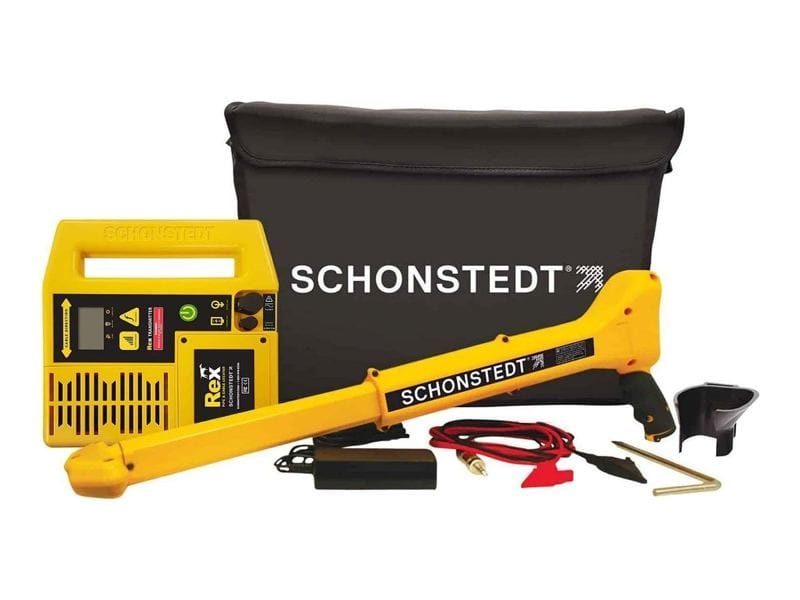
| Passive power plus three active frequencies, depth to about 19 ft | Schonstedt Rex receiver + transmitter | $4,040 |
| Depth and current readouts, A-frame for faults | Vivax-Metrotech vLoc3-Pro | $5,500 |
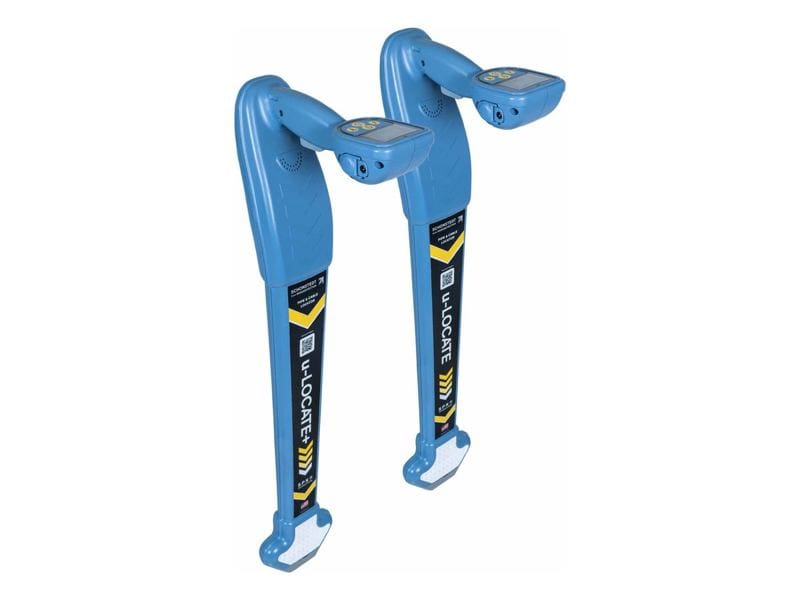
For a live yard wire, the Schonstedt u-Locate pipe and cable locator sweeps in passive mode on its own; add the transmitter for a dead wire. For crews who trace gas, water and electric from a single kit, the Schonstedt Rex pipe and cable locator has a passive mode, 512 Hz, 33 kHz and 82 kHz, and reads depth to about 19 ft. For fault-finding, the Vivax-Metrotech vLoc3-Pro shows the signal current with every depth reading and takes the A-frame. Already own a receiver? Our locator transmitters page shows which transmitter works with which. Need it for a single job? See rent or buy a pipe locator? for what rental stores charge.
Malone Detecting fits gas and public utility crews, the customers we mainly serve, who want the sale and the service from the same place: Joe Malone services the Schonstedt locators we sell.
Buying for an electrical contractor's truck? The best utility locators guide sets the u-Locate beside the other sets we sell.