Fisher TW-6 vs Vivax-Metrotech VM-810
By Malone Detecting Solutions · Updated
If you are weighing the Fisher TW-6 vs VM-810, the real split comes down to how you find a line and how you read its depth. Both are transmitter-and-receiver pipe and cable locators on nearly the same frequency:
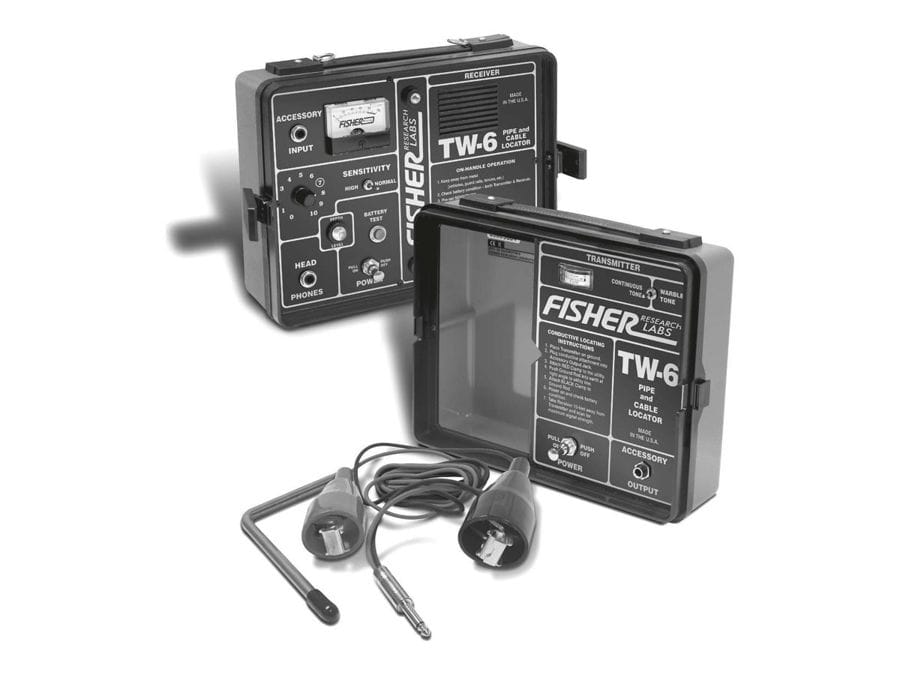
- Fisher TW-6, $908: two boxes that lock on a handle to sweep for unmarked lines, a needle meter, and depth worked out by hand with a bubble level. Runs 30 to 40 hours on 8 AA per unit.
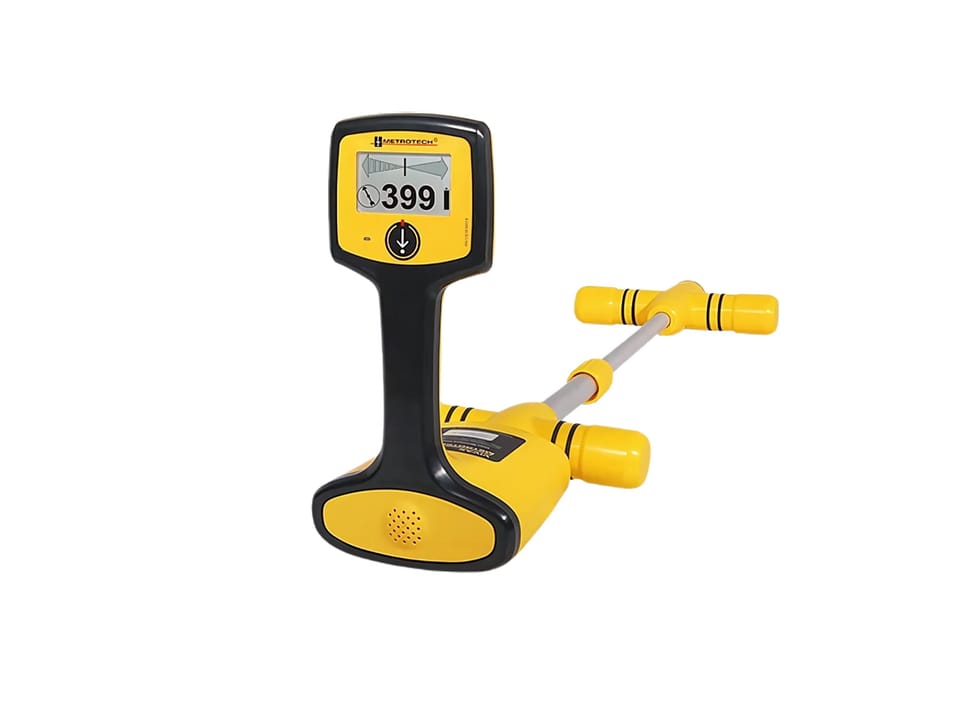
- Vivax-Metrotech VM-810, $3,667: built for water and gas lines, with one-button depth and signal current, a left/right needle with tones that go silent over center, and a sonde mode.
That is a $2,759 gap. Every detail below comes from Fisher's TW-6 manual and the Vivax-Metrotech VM-810 handbook, and both prices are ours.
On this page
- Do the TW-6 and VM-810 do the same job?
- What's the difference between the TW-6 and the VM-810?
- Which one finds a line nobody marked?
- How does each one give you depth?
- Which one keeps you on the right gas or water line?
- Can either one find plastic pipe?
- Batteries, weight and what the manuals leave out
- TW-6 or VM-810: which should you buy?
Do the TW-6 and VM-810 do the same job?
Yes. Both put a signal on a buried metal pipe or cable with a transmitter and trace it with a receiver. Both clip straight onto bare metal, clamp around a line, or induce a signal through the ground when there is no hookup. They even run on nearly the same frequency: 81.92 kHz on the TW-6 and 83 kHz on the VM-810.
So the extra $2,759 does not buy a different frequency. It buys what the VM-810 receiver adds: push-button depth and current, left/right guidance, and sonde mode.
What's the difference between the TW-6 and the VM-810?
The real differences sit in the receiver, the batteries, and what each maker puts in writing. Where a manual gives no figure, the table says so.
| Fisher TW-6 | Vivax-Metrotech VM-810 | |
|---|---|---|
| Our price (maker's list) | $908 ($956) | $3,667 ($3,860) |
| Frequency | 81.92 kHz | 83 kHz |
| Putting signal on the line | Direct connection, coupling clamp, or induction | Direct connection, signal clamp, or induction |
| Receiver readout | Needle meter and speaker | Backlit LCD, signal number, left/right needle, direction indicator, and tones |
| Depth | By hand: tilt to 45° with bubble level and back away | Push-button, within 5% when signal is clean |
| Signal current | None | Yes, shown with depth |
| Sonde mode | Not in manual, trace fish tape or snake instead | Yes |
| Batteries | 8 AA per unit, 30 to 40 hours per set | 2 D in receiver, 6 D in transmitter, hours not stated |
| Weight | 5 1/2 lb for both units | Not stated |
| Operating temperature | -10 °F to +120 °F | Not stated |
| Warranty | Not stated in manual | Not stated in handbook |
Which one finds a line nobody marked?
The TW-6 wins if you work alone. Mount both boxes on the 3-piece handle, tune a null away from cars and fences, and walk across where the line should sit. Mark your feet at the peak, cross back, mark it again, and split the difference. Repeat every 15 to 20 ft to plot the path. For a rough search, two people sweep across a street at least 30 ft apart.
The VM-810 searches blind too, though its handbook treats a ground survey as a two-person pass in both directions, one carrying the transmitter and one the receiver. Its signal spreads 8 to 10 ft on either side. Vivax-Metrotech ranks induction last because nearby lines pick up signal too, and warns it gets tough at 3 ft or deeper or in new backfill.
How does each one give you depth?
On the VM-810, hold the receiver upright with the tip on the ground over the line and press the button. You get depth and signal current together, within 5% on a clean signal. It reads to the center of the pipe, not the top, and the telescoping stem must be fully out or the reading is wrong.
On the TW-6, you work depth out by hand. Stand over the centerline, tilt to 45° with the bubble level, and back away at a right angle until the signal drops to its lowest point. That distance, minus 5 in., is the depth. On a slope, average both sides. Fisher's tracer probe does the job faster and more accurately.
Which one keeps you on the right gas or water line?
The VM-810 is built for it. Vivax-Metrotech designed it for water and gas distribution lines, and its 83 kHz signal crosses the insulators and rubber gaskets common in those systems. Its transmitter matches impedance automatically, and the handbook covers gas-crew work the TW-6 manual skips: bridging an insulated joint at a meter with a jumper cable and finding service laterals off a main.
The receiver tells you when you drift. A steady tone means the line is to your right, a pulsed tone means it is to your left, and the tone goes silent over center. Watch current as you walk: a sudden jump or drop means you passed a tee or left your line.
The TW-6 uses a needle meter and a speaker whose pitch keeps rising after the meter peaks at 100. Fisher's manual covers picking out one pipe near other lines and finding valves, tees, risers, and paved-over manhole covers.
Can either one find plastic pipe?
Not on its own. Both follow metal only. With the TW-6, push a fish tape or plumber's snake into the pipe and trace that. Because the signal stops where the tape stops, it also pinpoints a blockage, and it traces foil tracer tape over plastic pipe too. The VM-810 has Sonde mode: push a sonde down the pipe on a rod and follow it with the receiver, though the handbook does not say a sonde is included.
Batteries, weight and what the manuals leave out
- Batteries. The TW-6 takes 8 AA per box for 30 to 40 hours per set, and at least 30 to 40% more on alkaline. The VM-810 takes 2 D in the receiver and 6 D in the transmitter, with no hours stated.
- Weight and temperature. Fisher lists 3 lb for the TW-6 receiver, 5 1/2 lb for both units, and -10 °F to +120 °F operation. The VM-810 handbook lists neither.
- Water. Vivax-Metrotech says not to immerse any part of the VM-810. Fisher gives no water rating.
- Checks and calibration. Vivax-Metrotech asks for a weekly check on a known line, says not to open the housings, and sends recalibration to the factory or an authorized service center. The TW-6 has battery tests and a start-up null tune, with no calibration procedure listed.
- Warranty. Neither manual states a warranty. Ask about current terms before you order.
TW-6 or VM-810: which should you buy?
Which one fits depends on the lines you trace and how often you use it:
- Buy the TW-6 if you are a plumber or a small crew staying under $1,000, you mostly hunt for lines nobody marked, you can work depth out by hand, and you want AA batteries.
- Buy the VM-810 if you trace water and gas services every week, you need push-button depth and current before anyone digs, and you want left/right guidance to keep you on the right pipe.
Both are on our underground pipe locators page with the rest of the line, and our guide to the best utility locators puts them next to the Schonstedt and vLoc3 sets. If you only need one for a single job, read rent or buy a pipe locator first.
Questions buyers ask about the TW-6 and VM-810
Is the Fisher TW-6 a cheaper alternative to the VM-810?
Yes, for finding and tracing metal lines. At $908, the TW-6 costs $2,759 less than the VM-810 at $3,667 on nearly the same frequency. You give up push-button depth, current readings, left/right guidance, and sonde mode, so decide if you need depth at every mark first.
Does either one need a transmitter bought separately?
No, both come as transmitter-and-receiver systems. Fisher builds the TW-6 as a two-box set, and Vivax-Metrotech pairs the VM-810 transmitter and receiver with a carrying case. Neither manual prints a packing list, so confirm what accessories ship in the box before ordering.
Can either one tell you if a cable is live?
Don't count on either for that. The VM-810 handbook says to check with a voltmeter before connecting and use a clamp on live secondary power, while the TW-6 manual limits direct hookup to pipes and non-energized cables. Test any unknown cable with a voltmeter first.
Where do I see the price of each one?
On its own page: the TW-6 price and the VM-810 price, with how each one is used.
For a written quote on either locator, call 937-600-8155 or request a quote and tell us what you need to find.